USD
 INR

Call Us Now
+91 9106756572
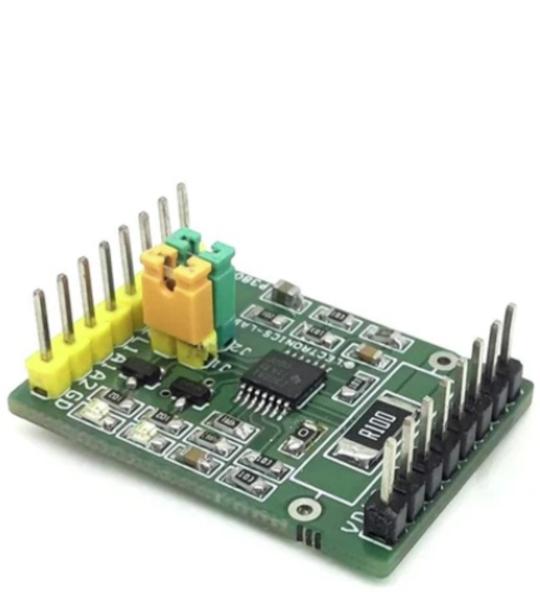
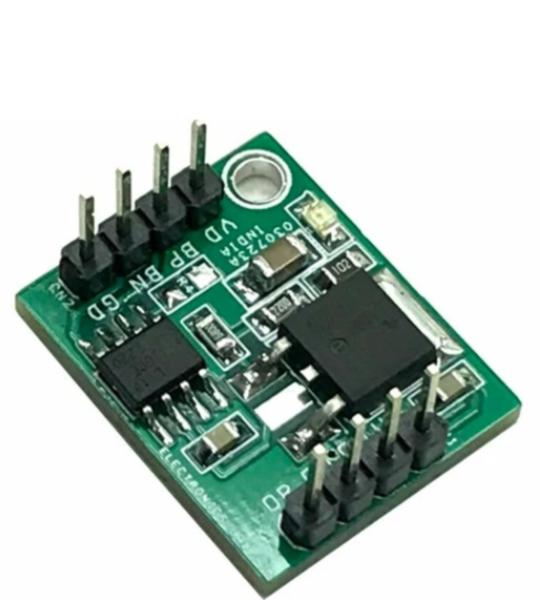
The project presented here is a high common-mode current sense amplifier with two high-speed comparators to detect out-of-range current conditions. The comparators are configured to detect and respond to dual over current conditions. These devices feature an adjustable limit threshold range for each comparator set using an external limit-setting resistor. Limit 1 Resistor is R10 and Limit 2 Resistor is R11. The board measures differential voltage signals on common-mode voltages that can vary from 0 V up to +36 V, independent of the supply.
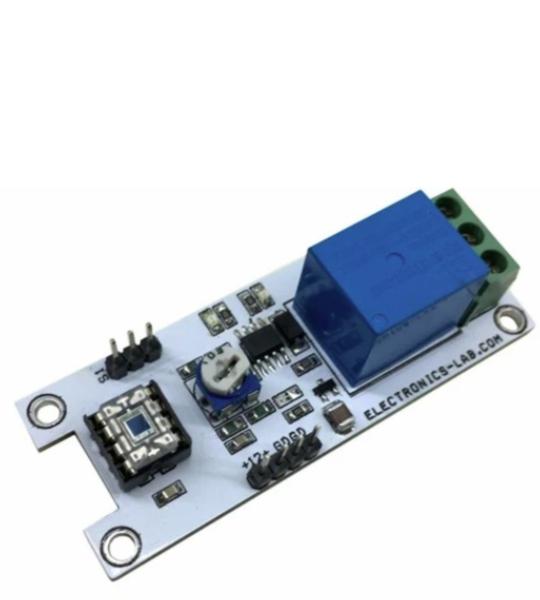
You may have seen many light-sensitive switch circuits based on an LDR sensor. Usually, the sensitivity of the LDR based light sensor is poor. We wanted a very sensitive light switch hence we decided to make a circuit based on a light sensor rather than LDR. After a little research on the internet, we found the OPT101 light sensor chip which includes a photodiode and a transimpedance amplifier in one package. The OPT101 light sensor provides an analog voltage output linearly proportional to light intensity.
This is a digital-output, current, power, and voltage monitor with an I2C and SMBus™-compatible interface with an integrated precision shunt resistor. It enables high-accuracy current and power measurements and over-current detection at common-mode voltages that can vary from 0 V to 36 V, independent of the supply voltage. Module is a bidirectional, low- or high-side, current-shunt monitor that measures current flowing through the internal current-sensing resistor. The integration of the precision current-sensing resistor provides calibration-equivalent measurement accuracy with ultra-low temperature drift performance and ensures that an optimized Kelvin layout for the sensing resistor is always obtained.
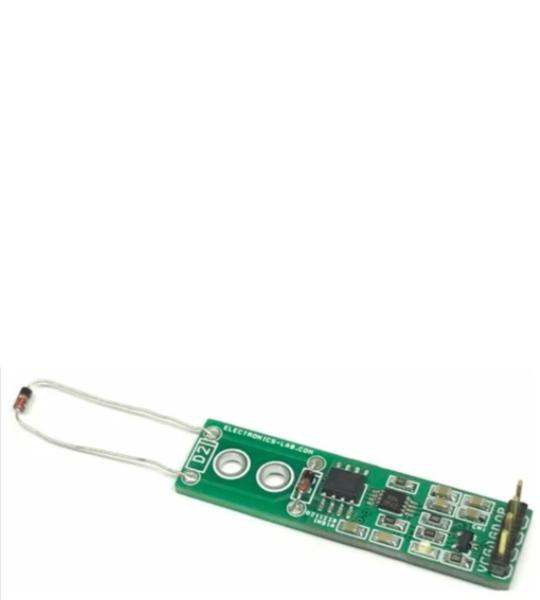
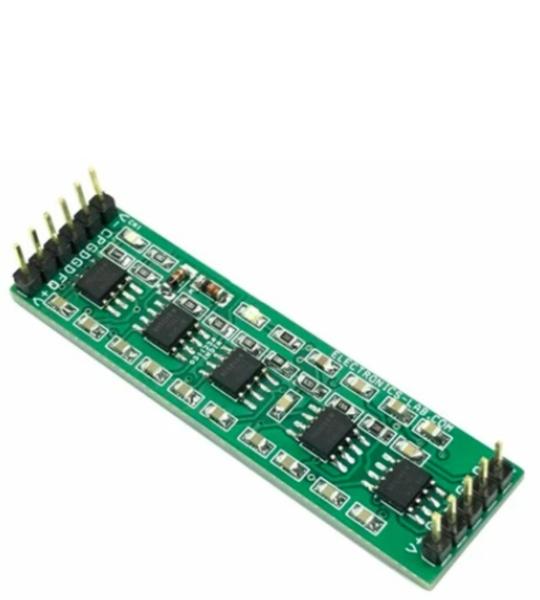
This airflow sensor consists of INA326 precision instrument amplifier, double 100uA REF200 current sources, and a REF3025 2.5V reference voltage chip. Airflow dynamics dictate how much the voltage will increase or decrease for a given airflow rate. Therefore, the relationship between temperature and flow rate would have to be established for a method such as this to be useable. Two IN4148 diodes are used to sense the temperature, Diode D3 should be in static air and Diode D2 should be installed in the airpath flow path. The circuit works with 5VDC and draws a few mA of current. REF3025 provides an accurate reference voltage which is 2.5V. Temperature linearity is within a tenth of a degree. The airflow is correlated to the change in D2 voltage. D2’s junction temperature and voltage are related to the airflow. D2 and D3 should be in the same temperature environment.
This is a simple signal conditioner circuit for Piezoelectric sensors. The circuit converts the input charge to voltage and the level shifts to the ADC input range of 0.1 V to 2.4 V. The circuit is built using AD8608 OPAMP from Analog devices. Piezoelectric elements are used to construct transducers for a vast number of different applications. Piezoelectric materials generate an electrical charge in response to mechanical movement, or vice versa, produce mechanical movement in response to electrical input. The board shown here is suitable for the Kistler type 8002K sensor. The K8002K is a high-precision accelerometer for shock and vibration measurements.
The module presented here is a sensor signal conditioner based on ZSC31010 CMOS integrated circuit, which enables easy and precise calibration of resistive bridge sensors via EEPROM programming. When mated to a resistive bridge sensor, it will digitally calibrate offset and gain with the option to calibrate offset and gain coefficients and linearity over temperature. A second-order compensation can be enabled for temperature coefficients of gain or offset or bridge linearity. ZSC31010 module communicates via IDT’s ZACwire serial interface to the host computer and it is easily mass-calibrated in a Windows environment. Once calibrated, the output signal pin can provide selectable 0 to 1 V absolute analog output; rail-to-rail ratiometric analog output; or digital serial output of bridge data with optional temperature data. U1 LM317 provides the 5V DC to the sensor chip. D1 is the power LED.
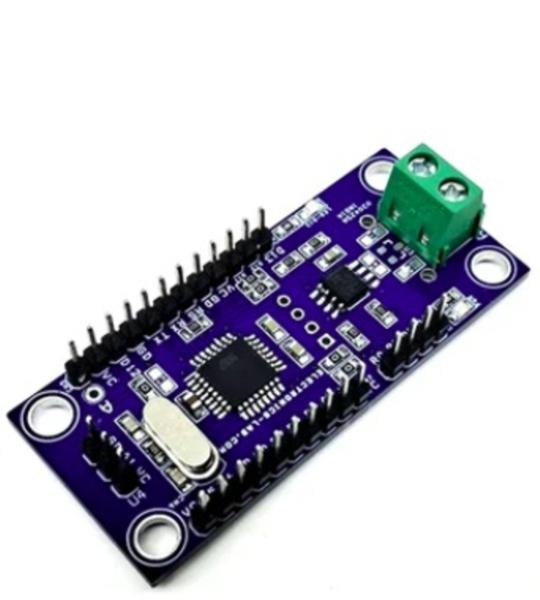
The RS-485 Linear Hall Sensor Interface Board is an Arduino-compatible module built around an ATmega328 microcontroller. It combines two Texas Instruments products: a SN65HVD08DR half-duplex RS-485 transceiver with a DRV5053 linear Hall-effect sensor on a single board. This creates a self-contained node that measures magnetic fields and reports data over an industrial RS-485 network.
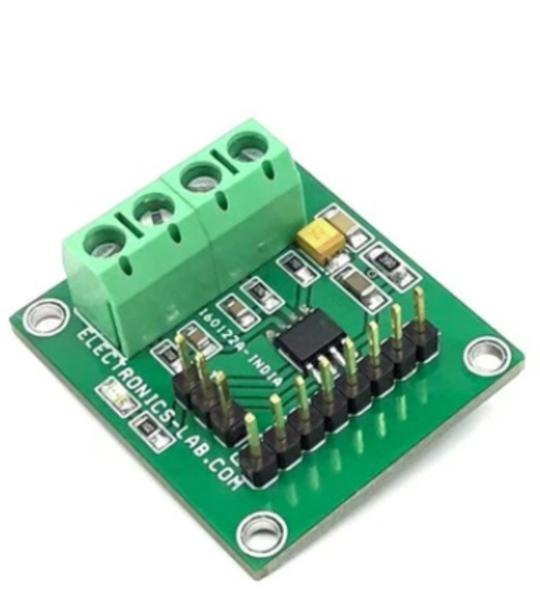
This is a new project, a single supply instrumentation amplifier with onboard bridge configuration, and a 2.5V precision reference voltage chip. The project can be configured for applications such as thermocouple amplifier, bridge amplifier, ECG amplifier, pressure sensors, medical instrumentation, portable instrumentation, RTD sensor amplifier. The project is based on INA333 micropower, zero drift, rail to rail out instrumentation amplifier chip. REF5025AID chip provides a precise 2.5V reference voltage. The board can be configured as an instrumentation amplifier or as a strain gauge amplifier with few easy changes.
The project presented here is an analog capacitive humidity sensor converter board suitable for various humidity measurement tasks. The circuit comes from Texas Instruments application note (see below). Most conventional capacitive proximity sensors produce a digital signal, but this circuit produces a DC output voltage that is a function of the relative humidity of the environment. The oscillator input for this circuit is a 1Khz sine source (1Vpp) feed to FQ input. The low frequency and sine characteristics keep RFI problems at a minimum. This sensor output converter may prove difficult to construct because of the small capacitances involved, parasitic capacitances in the sensor circuit, and noise pickup. The circuit requires an external 1Khz sinewave with 1Vpp signal and operates with a dual 15V DC supply.
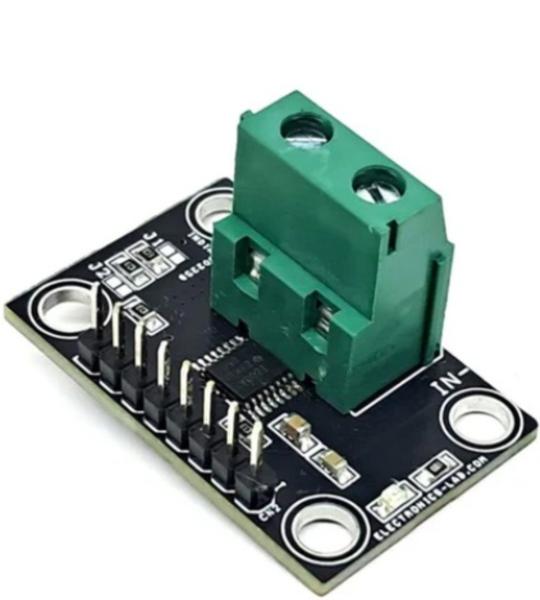
This product offers a dual−channel low component count interface solution for ground-referenced variable reluctance sensors. Each of the two identical channels interfaces with a variable−reluctance sensor, and continuously compares the sensor output signal to a user−programmable internal reference. An alternating input signal of appropriate amplitude at IN1 or IN2 will result in a rectangular waveform at the corresponding OUT1 and OUT2 terminal, suitable for interface to either standard microprocessors or standard logic families. A diagnostic input, common to both channels, provides a means to test for degradation or loss of the physical connector to both sensors. Each channel of the circuit has independent input bias and clamp circuitry, and independent comparators with Hysteresis voltage generators. Both channels share a common reference generator for normal and diagnostic modes. Basically, the circuit converts the sinewave signal of the sensor into a clean rectangular wave signal.
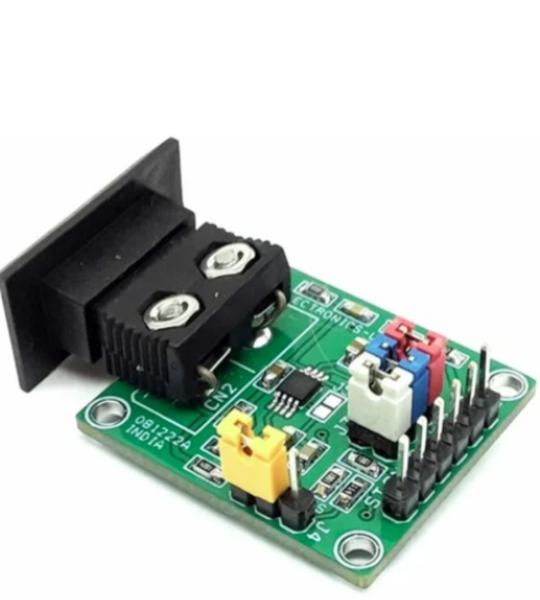
This Thermocouple Amplifier project provides a simple, low-cost solution for measuring thermocouple temperature. This board simplifies many of the difficulties of measuring thermocouples output. An integrated temperature sensor performs cold junction compensation. A fixed-gain instrumentation amplifier amplifies the small thermocouple voltage to provide a 5 mV/°C output. The high common-mode rejection of the amplifier blocks common-mode noise that the long thermocouple leads can pick up. For additional protection, the high impedance inputs of the amplifier make it easy to add extra filtering. The module can be used as standalone thermometers or as switched output setpoint controllers using either a fixed or remote setpoint control. The module can be powered from a single-ended supply (less than 3V) and can measure temperatures below 0°C by offsetting the reference input. To minimize self-heating, an unloaded AD8495 typically operates with a total supply current of 180 μA, but it is also capable of delivering in excess of ±5 mA to a load. The board can be interfaced with K-type (chromel-alumel) thermocouples. With an operating single supply of 5V, the 5 mV/°C output allows the devices to cover nearly 1000 degrees of a thermocouple’s temperature range. The project can also work with 3V supplies, allowing them to interface directly with lower-supply ADCs. They can also work with supplies as large as 36V in industrial systems that require a wide common-mode input range. The AD8495 cold junction compensation is optimized for operation in a lab environment, where the ambient temperature is around 25°C. The AD8495 is specified for an ambient range of 0°C to 50°C.
Cookie preferences